In the quiet chaos of an operating room, seconds can decide survival. For patients with internal organ injuries, stopping blood loss is often a desperate race against time. Now, scientists at Pohang University of Science and Technology (POSTECH) have developed a bioabsorbable sponge that can halt bleeding rapidly while helping the body heal itself.
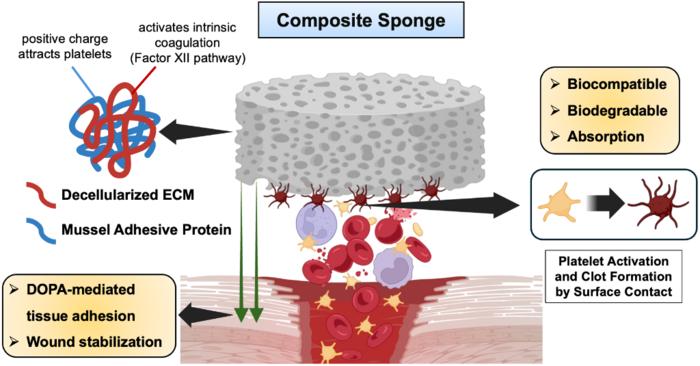
The new material combines two natural powerhouses: mussel adhesive protein and decellularized extracellular matrix, or dECM. The result is a composite hemostatic sponge that clings tightly to wet tissue, seals wounds, and then safely degrades once its job is done. When pressed against a bleeding site, it quickly absorbs blood and forms a robust seal that activates the body’s own clotting system. As the sponge dissolves, the dECM scaffold promotes tissue repair without triggering inflammation or leaving behind debris.
Nature’s Glue Meets the Body’s Blueprint
Mussels have long fascinated biomaterials researchers for their uncanny ability to stick to rocks, ships, and shells under turbulent seawater. Their secret lies in specialized adhesive proteins rich in catechol and amine groups, which create strong covalent and hydrogen bonds even in wet environments. By integrating this natural glue with dECM derived from animal tissue, the POSTECH team engineered a synthetic composite that mimics both the mechanical grip of mussels and the regenerative support of the body’s own tissue matrix.
“This composite sponge can stop bleeding quickly and safely even in severe internal injuries that were previously difficult to control,” said Professor Hyung Joon Cha of POSTECH, who led the study. “By reducing the need for additional surgeries and supporting faster recovery, it has the potential to greatly improve patient care.”
The researchers tested the material in a rat model of liver injury, including animals treated with warfarin to simulate anticoagulated bleeding. The sponge adhered strongly to the damaged surface and drastically shortened bleeding time. Compared to conventional agents like Surgicel or Avitene, it caused less inflammation and tissue damage while accelerating the early stages of healing. Under the microscope, liver sections showed cleaner wound margins and fewer signs of necrosis or fibrosis.
From Sea to Surgery
The innovation addresses two long-standing problems in surgical hemostasis: poor adhesion and non-degradability. Many commercial products either fail to stick in wet conditions or persist in the body, risking infection or chronic inflammation. The new MAP-dECM composite avoids both pitfalls by balancing adhesive chemistry with biodegradable structure. Once the bleeding stops, enzymes naturally break it down, leaving no trace.
The implications extend beyond emergency medicine. Internal bleeding during tumor resections, organ transplants, or trauma surgery could be managed more safely, especially for patients on blood thinners. Because the material degrades in harmony with the body’s healing timeline, it may also find use in minimally invasive or robotic procedures where removal of residual material is difficult.
“By activating the body’s intrinsic coagulation pathways, the dECM helps accelerate blood clotting and promote wound stabilization,” the researchers wrote. “This synergy between adhesion and regeneration is key to its superior performance.”
The study, supported by the National Research Foundation of Korea and the Alchemist Project, appears in Advanced Healthcare Materials. Its success demonstrates how lessons from nature’s underwater engineers can save lives in the most delicate human operations. As bioinspired design continues to merge with medical science, even the humble mussel may help rewrite the rules of emergency care.
Advanced Healthcare Materials: 10.1002/adhm.202502994
If our reporting has informed or inspired you, please consider making a donation. Every contribution, no matter the size, empowers us to continue delivering accurate, engaging, and trustworthy science and medical news. Independent journalism requires time, effort, and resources—your support ensures we can keep uncovering the stories that matter most to you.
Join us in making knowledge accessible and impactful. Thank you for standing with us!