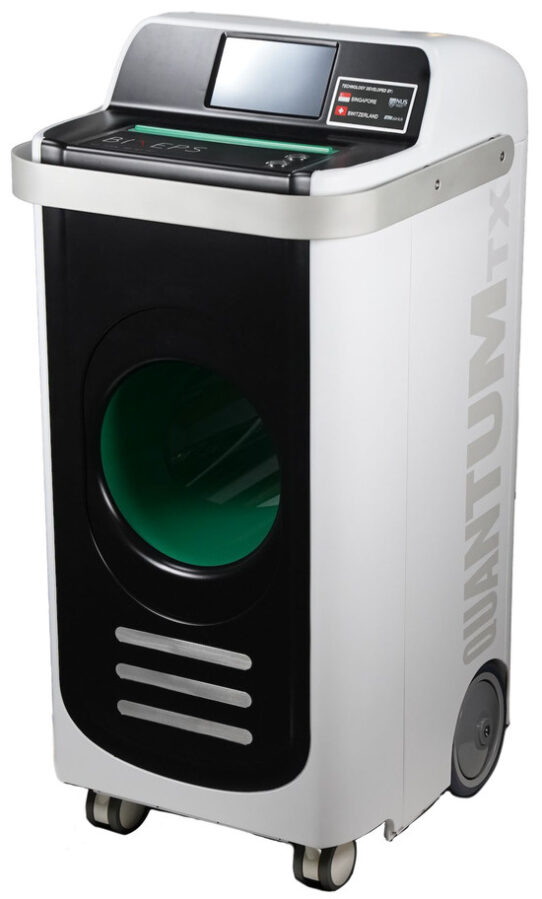
In a clinic room in Singapore, patients sat quietly with one leg inside a plastic chamber while a gentle magnetic field pulsed through muscle. The setup looked more spa than gym, but the biology was decidedly about endurance training.
A new exploratory study from Singapore General Hospital and the National University of Singapore suggests that weekly low dose magnetic pulses can nudge muscles to act like they have exercised, with early signs of improved glucose control for patients with type 2 diabetes who carry excess abdominal fat.
The approach is called magnetic mitohormesis. Instead of treadmill time, it uses pulsed electromagnetic fields to stimulate mitochondria rich muscle fibers and activate the same metabolic pathways triggered by endurance exercise. In the trial, 40 adults with suboptimally controlled diabetes received 12 weekly sessions, each lasting 10 minutes per leg on alternating weeks. No participants reported side effects. As a group, patients showed no significant change in HbA1c or fasting glucose, but a prespecified subgroup with central obesity, defined by high waist to hip ratio, did. Nearly nine in ten of those patients saw HbA1c fall, on average from 7.5 percent to 7.1 percent over three months.
The result is modest, and the authors are careful to frame it that way. Still, for patients who struggle with exercise because of age, comorbidities, pain, or fatigue, a safe, passive intervention that produces even a fraction of exercise like benefit is notable. It also hints at a larger principle that tiny, precisely delivered physical cues can produce systemic metabolic shifts through muscle secreted signals and improved mitochondrial function.
“We (doctors) often tell patients with diabetes to exercise because it helps control blood sugar, but we found that most people (over eight out of 10 in our study) do not exercise regularly.”
That plain reality, voiced by senior author Dr Tan Hong Chang of Singapore General Hospital, sets the clinical context. In this study, adherence was high, with 77.5 percent completing all 12 sessions and the remainder missing only one or two. Sessions were brief and involved sitting, not sweating, which likely explains the strong completion rate.
How A Magnet Imitates A Run
Mechanistically, the team describes low frequency pulses that appear to activate a calcium mitochondrial axis upstream of PGC 1 alpha, the transcriptional coactivator central to building new mitochondria and enhancing fatty acid oxidation. Prior human and animal work from the group and others has linked similar exposures to increased lean mass, reduced visceral adiposity, stronger knee extensors, and lower circulating lipotoxic ceramides. In the present trial, the strongest glycemic signal appeared among those with central obesity, a phenotype often marked by impaired muscle mitochondrial function and lipid spillover. If the treatment gently exercises muscle at the cellular level, patients with more dysfunctional muscle may have more to gain.
The protocol was intentionally simple. Each week, a participant placed one leg into a chamber built around a Helmholtz coil design that maintains uniform magnetic fields across the thigh. Peak flux densities reached about 1 millitesla. The following week, the other leg received the same stimulus. Medications, diet, and activity were held constant during the study to isolate the magnetic exposure.
Promise, With Caveats
This was a single arm exploratory study, not a randomized controlled trial. The overall cohort did not improve in HbA1c, fasting glucose, or HOMA IR, and there were no significant shifts in body weight, body composition, blood pressure, lipids, or renal function over three months. The subgroup signal by waist to hip ratio, while statistically significant, requires confirmation under blinded, controlled conditions. The authors note potential conflicts and funding support, including A*STAR and QuantumTX, and they call for larger studies to determine dose, frequency, and which clinical profiles benefit most.
Still, the ease of delivery and the absence of adverse events make the idea hard to ignore. A brief, non strenuous exposure that coaxes muscle to secrete healthier signals and burn fat more efficiently could complement medication regimens, especially for patients who cannot meet activity guidelines. The concept also aligns with a broader shift in metabolic research toward targeting mitochondrial efficiency and inflammation via gentle stressors that train tissues to become more resilient.
“Our early research has shown potential across areas such as health enhancement, sustainable food production, and medical therapy.”
That line from corresponding author Professor Alfredo Franco Obregon, who helped pioneer the approach at NUS, situates magnetic mitohormesis in a wider landscape of bioengineering. The claim remains expansive, and the clinical data here are early. Yet the image is memorable, and it matters. A quiet room, a patient resting in a chair, a coil humming softly, and a metabolic system nudged in the right direction. If larger trials uphold the subgroup benefit, magnets could join the diabetes toolkit as a low effort adjunct that mimics a jog where a jog is not possible.
Journal of Clinical Medicine: 10.3390/jcm14186413
If our reporting has informed or inspired you, please consider making a donation. Every contribution, no matter the size, empowers us to continue delivering accurate, engaging, and trustworthy science and medical news. Independent journalism requires time, effort, and resources—your support ensures we can keep uncovering the stories that matter most to you.
Join us in making knowledge accessible and impactful. Thank you for standing with us!