Between 2000 and 2016, Peru – home to more than 70 per cent of the world’s tropical glaciers – lost roughly 29 per cent of its glacial area. At the current rate of retreat, these glaciers could disappear entirely by 2056, according to the Journal of Water and Climate.
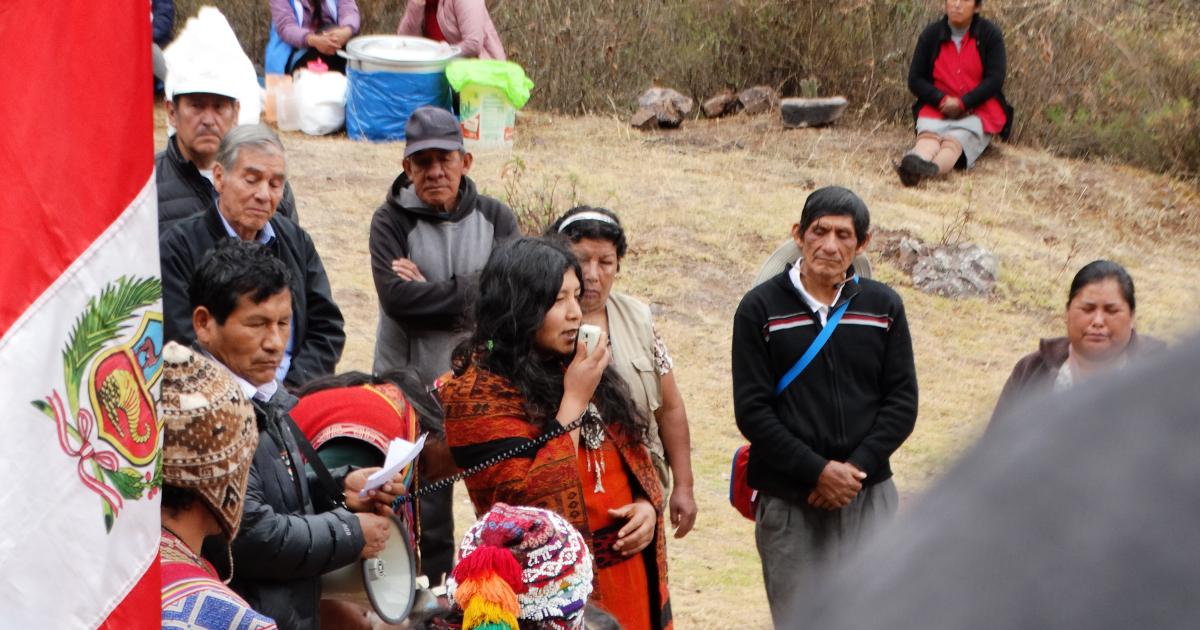
Jenny’s understanding of this crisis is deeply personal. She grew up in Cocha Hongo, a small agricultural community in the Llanganuco basin, where her campesina grandmother taught her to respect the land and water.
“The communities most affected by the changing climate are those that depend on agriculture and livestock,” she explains. “This isn’t new. Even in the 1980s, farmers told me that too much rain was damaging their crops – especially potatoes – and bringing more pests.”
Nourish
As rainfall patterns grow erratic and temperatures rise, the Andean agricultural calendar has lost its rhythm. “There isn’t an immediate government response,” Jenny told The Ecologist.
“Measures exist, but they’re limited. Families are forced to manage on their own, often sacrificing other things – like their children’s education – when crops fail. The poorest communities are always hit hardest. And within those, women even more so.”
The Andes are not only mountains, they are living systems. Their glaciers, wetlands, and rivers feed both local valleys and distant regions. Meltwater from Andean glaciers helps sustain the Amazon Basin, where many rivers originate in the Peruvian and Bolivian ranges of Vilcanota, Carabaya, and Apolobamba.
The relationship between the Andes and the Amazon is deeply intertwined: the mountains force warm, moist air from the Atlantic to rise, cool, and condense, producing the rains that feed the rainforest.
In turn, the Amazon releases vast amounts of moisture back into the atmosphere, creating “flying rivers” that return to nourish the Andes. When the glaciers vanish, this cycle begins to falter.
Combustion
Tropical glaciers, those found in high-altitude regions near the equator, are especially vulnerable to warming. Andean glaciers have reached their lowest levels in more than 11,700 years, according to a recent paper published by Science.
One of the lesser-known consequences of glacial retreat is acid rock drainage. As ice melts, it exposes rocks that haven’t been touched by air or water for millennia. When these rocks contain sulfides, they react with oxygen and moisture to produce acidic runoff rich in heavy metals.
In Huaraz, the capital of Ancash, with approximately 150,000 residents, acid drainage has already forced the city to abandon two of its main watersheds due to contamination.
“Here in Huaraz, the city depends on just one sub-basin that is safe and free from contamination,” Jenny says. “But even within the same Cordillera Blanca, some areas have abundant water while others face scarcity and contamination.”
Another factor accelerating glacial melt is black carbon, a soot-like residue from the incomplete combustion of fossil fuels, biofuels, and biomass. Deposited on snow and ice, it darkens the surface and increases heat absorption.
Inequality
One study has detected black carbon from burning in the Amazon settling on Andean glaciers. When this soot enters meltwater streams, it may also contaminate water sources downstream – though research on its local impacts remains limited.
The Río Santa, which once carried clean glacial water north through Huaraz to the Pacific, is now heavily polluted. Nearly 85 per cent of sampled sites exceed safe limits for at least four elements, with arsenic showing concentrations ten times higher than recommended, research has found.
These pollutants stem largely from mining operations – both active and abandoned.
One of the largest gold mines in the Callejón de Huaylas valley began surface extraction in 1998. But the roots of Peru’s mining industry run far deeper, tracing back to the forced labour systems of Spanish colonial rule between 1532 and 1800, as archaeologist Sarah Kennedy notes in an article in Sapiens.
The legacy of exploitation continues in new forms – through environmental destruction, corruption, and social inequality. Antamina, one of the largest mines in Peru, has just had a license renewed for another 30 years.
Resistance
Despite limited state support, Andean communities are not standing still. Across the highlands, farmers are reviving ancestral practices to adapt and survive.
Some are reintroducing native plants that retain moisture and restore wetlands (bofedales). Others are repairing pre-Columbian irrigation systems – stone canals and terraces that slow water loss and prevent erosion.
In some regions, ayllus (traditional community groups), NGOs, researchers, and local governments are collaborating to restore puna grasslands, replant queuña forests, and build artificial lagoons to store rainwater for the dry season.
“These efforts aren’t just adaptation,” Jenny says. “They’re acts of resistance – a refusal to let our land and culture disappear.
“We can’t wait for solutions to come from above. People here have always known how to live with the mountains. What they need is to be heard and supported, not ignored.”
This Author
Yasmin Dahnoun is an environmental writer, artist and activist. She’s currently a co-editor for the Green Dreamer podcast.
This article has been published through the Ecologist Writers’ Fund. We ask readers for donations to pay some authors £250 for their work. Please make a donation now. You can learn more about the fund, and make an application, on our website.