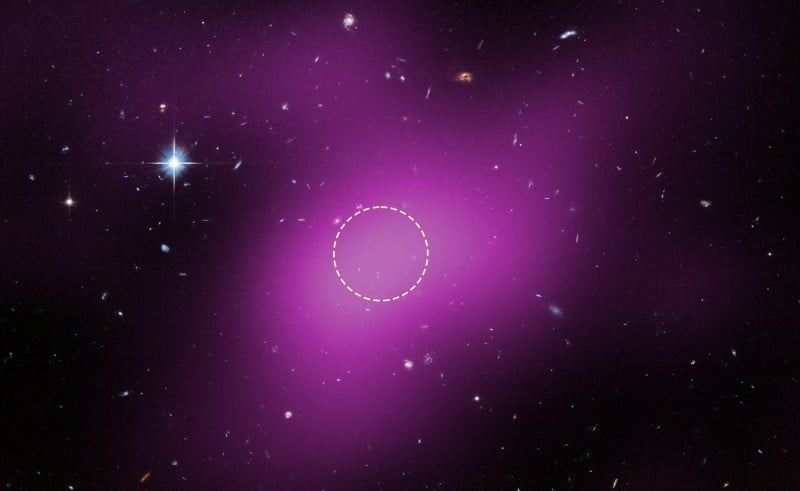
Imagine a structure massive enough to hold billions of suns’ worth of matter, yet producing no light whatsoever. Astronomers have now confirmed such an object exists: a spherical cloud of gas sitting near the spiral galaxy Messier 94, about 16 million light-years away, that should have become a galaxy but never ignited a single star.
The object, nicknamed Cloud-9, was first spotted by China’s Five-hundred-meter Aperture Spherical Telescope through its cold hydrogen signature. Radio observations revealed the gas but couldn’t determine if faint stars were hiding inside. Deep imaging from Hubble’s Advanced Camera for Surveys has now settled the question definitively. There are no stars. Objects initially appearing within Cloud-9’s boundaries turned out to be distant background galaxies – like opening a darkened house to discover it was always empty.
This makes Cloud-9 the first confirmed example of what theorists call a RELHIC: a Reionization-Limited H I Cloud. These are predicted fossils from the early universe – dark matter halos that accumulated gas but were never quite massive enough to overcome the intense radiation that flooded space during cosmic dawn. Finding one intact is like discovering a pristine foundation stone left over from when the local universe was being built.
The Physics of Failure
Cloud-9 exists in a narrow cosmic sweet spot. Its hydrogen core spans roughly 4,900 light-years and contains about a million solar masses of gas. But the way that gas stays coherent tells a more interesting story. Calculations suggest the cloud sits within a dark matter halo weighing approximately five billion solar masses – far heavier than the visible gas alone could explain.
Had the cloud been much more massive, gravity would have compressed the gas until nuclear fusion began. Much smaller, and the early universe’s ionizing radiation would have stripped the gas away entirely or heated it too much to remain bound. Instead, Cloud-9 occupies the threshold where it could survive for billions of years without collapsing into stars or evaporating into space.
“In science, we usually learn more from the failures than from the successes,” explains Alejandro Benitez-Llambay, the study’s principal investigator at the University of Milan-Bicocca. “In this case, seeing no stars is what proves the theory right.”
For researchers, that emptiness is scientifically valuable. Normal galaxies contain stars whose light and supernovae constantly stir their surrounding gas, making it difficult to isolate the underlying dark matter’s behavior. Cloud-9 offers something cleaner – a laboratory where astronomers can study how invisible matter structures itself on small scales without stellar interference muddying the measurements.
Suburban Survival and Hidden Populations
Cloud-9’s location matters to its survival. Floating in what amounts to the galactic suburbs near M94, it avoids the violent tidal forces that would tear it apart closer in. High-resolution data from the Very Large Array does show slight distortion in the cloud’s shape, likely from ram pressure as it moves through the outer reaches of M94’s gaseous halo. That interaction might eventually trigger star formation if the cloud continues accreting mass, but for now it remains the purest dark galaxy example yet confirmed.
The discovery raises a broader question: how many more failed galaxies are out there, invisible except through radio observations most surveys aren’t designed to detect? Theoretical models suggest these objects should be relatively common in the early universe, and many could have survived to the present day near larger galaxies. Cloud-9 might represent just the first of a hidden population that’s been orbiting in plain sight, waiting for the right combination of radio sensitivity and optical follow-up to reveal their empty interiors.
Future radio surveys with enhanced sensitivity could systematically search for similar hydrogen clouds, while space telescopes verify their starless nature. Each confirmed example would help refine models of how the smallest dark matter halos behaved during the universe’s first billion years – a period when the framework for all later structure was being laid down, even if not every piece ultimately lit up.
The Astrophysical Journal Letters: DOI 10.3847/2041-8213/adae94
If our reporting has informed or inspired you, please consider making a donation. Every contribution, no matter the size, empowers us to continue delivering accurate, engaging, and trustworthy science and medical news. Independent journalism requires time, effort, and resources—your support ensures we can keep uncovering the stories that matter most to you.
Join us in making knowledge accessible and impactful. Thank you for standing with us!