Three companies control four out of every five prescriptions filled in America. CVS, UnitedHealth, Cigna. These pharmacy benefit managers sit at a peculiar crossroads in healthcare, acting as middlemen between patients, insurers, and drug manufacturers. For years, when regulators questioned whether PBMs were inflating drug prices, the companies had a ready defence: we barely make any money at all.
They reported profit margins of 4% to 7%, the thinnest in healthcare, supposedly evidence of fierce competition and lean operations. Across the industry, the argument was straightforward. If PBMs controlled such vast pharmaceutical flows yet operated on razor-thin margins, surely they weren’t the culprits driving up medication costs.
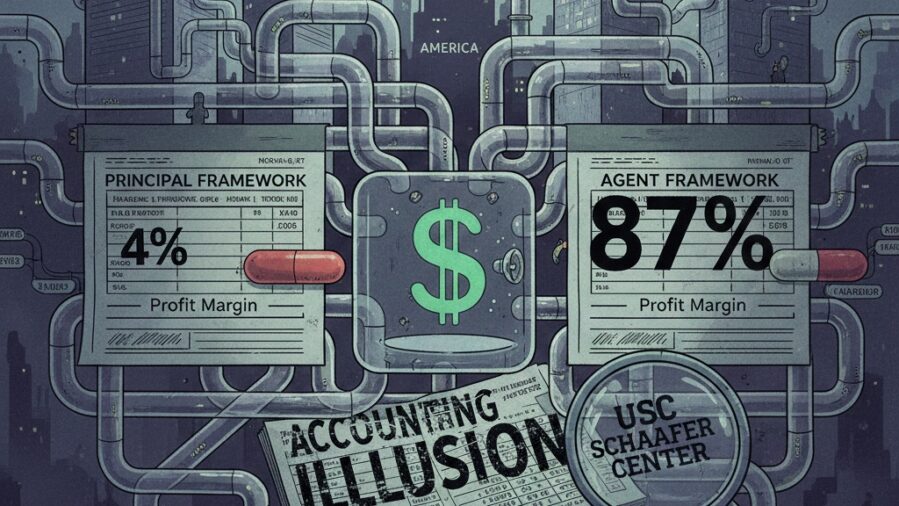
Except that argument rests on an accounting illusion.
Researchers at the USC Schaeffer Center for Health Policy & Economics have spent months with spreadsheets and financial statements, tracing money as it moves through the pharmaceutical supply chain. What they discovered unsettles the entire narrative: those slim margins aren’t proof of competition. They’re proof of clever accounting.
“The choice of how you count revenue makes an enormous difference,” says Karen Mulligan, the research scientist who led the analysis. The example she provides is stark. Take a single prescription for a drug listed at $360. Apply one accounting framework, what accountants call the principal approach, and the PBM’s profit margin appears to be around 10%. Adjust the framework slightly, using what’s known as the agent approach, and suddenly the margin jumps to 87%. The profit hasn’t changed. The actual money hasn’t moved differently. Only the accounting rules have shifted.
This isn’t an obscure technical detail. It’s the foundation of how regulators, policymakers, and the public understand whether PBMs are extracting unreasonable profits from the healthcare system. And for decades, it’s been wrong.
Where the Money Actually Goes
To understand how PBMs hide their profits, you need to follow the cash. A patient walks into a pharmacy with a prescription. The pharmacy fills it and charges $360 for the drug. But the pharmacy doesn’t keep that money. Instead, it gets reimbursed by a PBM, which collected that money from an insurer, which collected premiums from employers and individuals.
Tangled within these flows are rebates from drug manufacturers, administrative fees, transaction charges, and markups. The PBM’s job is to manage this complexity: to negotiate rebates with manufacturers, process claims from pharmacies, and direct money between all the parties. They’re intermediaries, and traditionally, accountants have treated them in two different ways.
Under the principal framework, you record every dollar that passes through the PBM as both revenue and expense. The insurer sends $360 to the PBM; the PBM records that as revenue. The PBM then sends $360 to the pharmacy; the PBM records that as an expense. On paper, this inflates the reported revenue. The PBM’s actual earnings, the transaction fees and markups they keep, get buried under hundreds of billions of dollars in pass-through payments.
Under the agent framework, you only count the money the PBM actually keeps. The transaction fees. The markups on medications. Everything else is invisible in the financial statements. Same company, same actual profits, radically different reported earnings.
“Accounting practices make it difficult to judge the health and efficiency of the PBM market, particularly as dominant firms have become part of larger, more complex companies,” Mulligan explains. This second part matters as much as the first. Because the PBM industry has undergone a dramatic transformation in the past decade, and that transformation has made the accounting problem infinitely worse.
The Consolidation Trap
CVS didn’t start as a pharmacy. It became one, swallowing Aetna insurance. UnitedHealth doesn’t just manage benefits. It owns Optum, which owns specialty pharmacies, clinics, and drug distribution networks. Cigna operates as an integrated health conglomerate spanning insurance, pharmacy services, and medical care. These vertical integrations, one company owning every step of the supply chain, made financial sense from a business perspective. They’re less transparent from an accounting one.
When a PBM and an insurer and a specialty pharmacy were separate companies, money flowing between them left a trail. It appeared in financial statements. Regulators and analysts could see it. Now, when money moves between a PBM’s division and an insurance division owned by the same parent company, something curious happens: the transaction becomes an internal transfer, invisible in public financial statements.
Darius Lakdawalla, chief scientific officer at the Schaeffer Center, describes the consequence bluntly. “True transparency requires greater visibility into profit flows hidden inside increasingly complex corporate structures,” he says. In practice, this means a publicly traded healthcare conglomerate can shift billions of dollars between its various arms in ways shareholders and regulators simply cannot observe. A specialty pharmacy charging inflated prices to a PBM within the same company? The profit margin looks different depending on where you draw the corporate boundaries.
The research team illustrates this with their own hypothetical example. Using their simplified $360 drug scenario, they calculate what reported profit margins look like under three different scenarios: if the PBM operates independently and uses principal accounting (10% margin), if the same PBM operates within a conglomerate and those internal transfers become invisible (5.3% margin), or if we adopt agent accounting and exclude pass-through payments entirely (82.7% margin).
Same company. Same actual profits. Three completely different stories about how much money it’s making.
The Narrative Unravels
This matters because the reported margin shapes everything else. When Congress considers legislation to reform PBM practices, some argue that regulation might be pointless. The companies already operate at such low margins that there’s little room to cut. When the Federal Trade Commission scrutinises PBM business practices, the companies point to their thin margins as evidence they lack market power. When investors decide whether to buy healthcare conglomerate stocks, they consider reported profitability a measure of operational efficiency.
All of these conversations rest on numbers that accountants chose to compile in a particular way. And the choice, the research makes clear, is largely discretionary. Professional accounting guidelines permit PBMs to elect which framework to use. The decision isn’t driven by the economics of their business. It’s driven by which accounting approach produces lower reported margins.
The irony is that the actual profitability, the dollars the PBM actually keeps, hasn’t changed at all. As Mulligan and Lakdawalla note, accounting principles do not affect the economic reality of how much money flows to shareholders. But accounting principles absolutely affect how that reality appears in the light of public scrutiny. And light, or the absence of it, shapes policy.
There’s another layer to this opacity. Rebate payments have historically been the largest source of PBM revenues. But in recent years, PBMs have shifted their business model. In 2012, rebates accounted for roughly 46% of gross PBM profits. By 2020, that had collapsed to just 14%. Where did the money come from instead? Fees. Direct payments from insurers and specialty pharmacies for processing claims, managing formularies, conducting prior authorisations. These fee-based revenues are harder to hide because they don’t flow through the same pass-through payment mechanisms.
Yet the vertical integration problem persists. When a PBM-owned specialty pharmacy pays a PBM-owned claims processing division a service fee, that transaction still disappears inside consolidated financial reporting. The conglomerate can combine results for the entire pharmacy services division, merging the PBM, the specialty pharmacy, and the group purchasing organisation all into one line item in public financial statements. Policymakers trying to understand PBM profitability face a puzzle with missing pieces.
What Transparency Might Look Like
The research team doesn’t propose a single solution. Instead, they offer policymakers several reform options. The most straightforward: require PBMs to report revenues net of pass-through payments, effectively forcing them to use the agent framework. Other industries already do this. It’s not radical. It’s just… transparent.
A second approach goes deeper. Rather than trying to fix the accounting treatment of pass-through payments, regulators could require healthcare conglomerates to disaggregate their financial reporting. Report the PBM’s performance separately from the specialty pharmacy’s performance. Separately from the insurance arm. Let investors and regulators see each business unit’s true profitability. The financial sector does this for interest income, trading gains, and underwriting revenues. There’s precedent.
“Greater financial disclosure requirements for PBMs are needed to develop a better picture of how PBMs make money and the extent to which these practices may raise costs for consumers,” Mulligan says. This isn’t about declaring war on an industry. It’s about ensuring that the evidence policymakers base decisions on actually reflects economic reality rather than accounting convention.
Because here’s what happens when reported profits don’t match economic reality: policymakers underestimate market power. Regulators assume competition is fiercer than it is. Legislation gets written with one set of assumptions about industry structure and profitability. The industry operates under a completely different set of actual constraints. And in that gap between assumption and reality, the byzantine complexity of the pharmaceutical supply chain persists largely unreformed.
The bigger picture is that this accounting opacity only addresses one part of the problem. Even if PBMs tomorrow began reporting their true profitability accurately, the question of drug prices would only be partially answered. Rebates totalled $356 billion in price concessions for branded drugs in 2024 alone. Where those rebates go, how much reaches patients versus insurers versus PBMs, whether they actually lower drug prices or simply shuffle money between corporations. Those questions remain murky.
But it’s a place to start. Because you cannot fix a system you cannot see. And right now, beneath layers of accounting practices and corporate structure, the real economics of how Americans pay for medicines remains largely hidden from view. The PBMs maintain that they barely profit. The evidence suggests something more complicated. A system designed, perhaps deliberately, to make seeing the truth extraordinarily difficult.
White Paper link: https://schaeffer.usc.edu/research/pbm-profitability/
If our reporting has informed or inspired you, please consider making a donation. Every contribution, no matter the size, empowers us to continue delivering accurate, engaging, and trustworthy science and medical news. Independent journalism requires time, effort, and resources—your support ensures we can keep uncovering the stories that matter most to you.
Join us in making knowledge accessible and impactful. Thank you for standing with us!