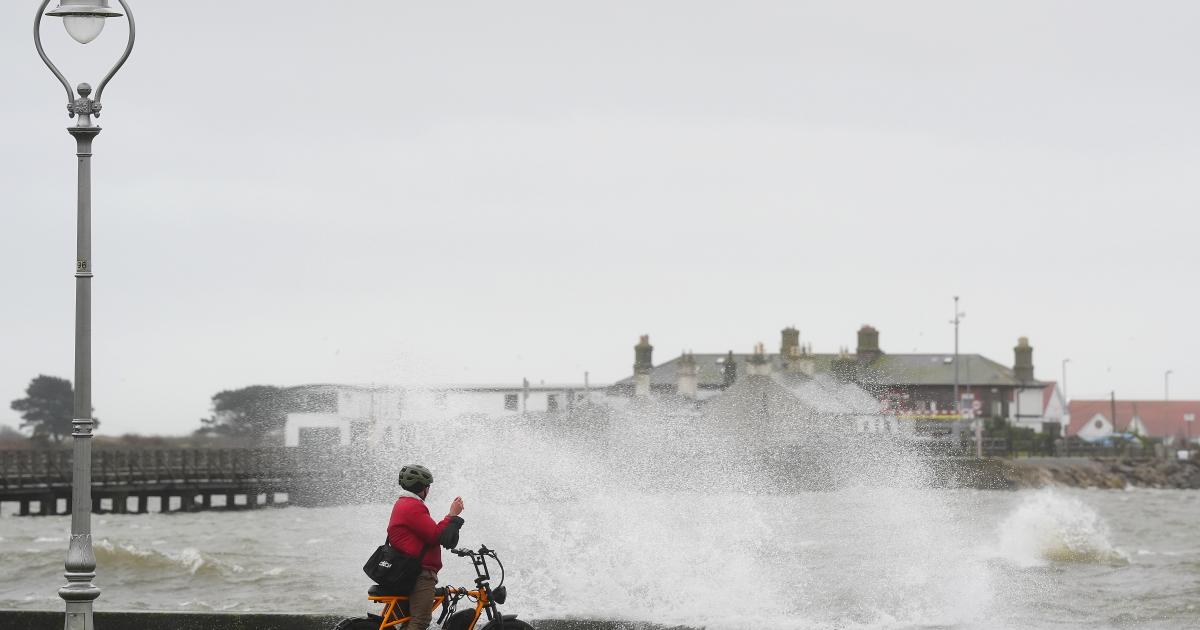
Sea levels around the world’s coasts are higher than modelling often assumes, potentially putting millions more people at risk from rising oceans, scientists have said.
READ: HELL AND HIGH WATER
Researchers have warned of a “blind spot” in many studies into the impacts of rising seas and other hazards for people living on coastlines around the world, which have frequently underestimated current sea levels.
As a result, more land and people could be at risk from climate change-driven rising seas, and for impacts to hit sooner than previously thought, the scientists from Wageningen University and Research in the Netherlands warn.
Implications
In a study published in the journal Nature, they said that 90 per cent of coastal hazard studies use land elevation measurements and then rely on “geoid” models that make estimates for sea levels based on gravity and the rotation of the Earth.
But actual sea height is also determined by ocean currents and large-scale circulation, winds, tides, seawater temperature and water saltiness, Dr Philip Minderhoud, one of the study authors said.
“Our results show how important it is to account for this difference by using actual sea-level measurements instead of the widely-used assumption that geoid height equals present mean sea level”, he said.
The study calculated the difference between coastal land elevation and sea level around the world and compared it to 385 recently published studies.
The findings suggest most research has underestimated coastal sea-level height across the world by an average of 30cm (1ft), while in some areas of the world such as south-east Asia and the Indo Pacific sea levels are around one metre (3ft) higher on average than previously thought.
The findings have significant implications for coping with one of the major impacts of climate change – rising sea levels as the oceans warm and ice melts.
Hit
The most recent UN science review projects rises of between 0.28m and 1.01m by the end of this century, compared to 1995-2014 levels.
Study co-author Katharina Seeger said: “Our calculations show that measured coastal sea levels in many places on Earth are higher than is often assumed in coastal impact studies.”
And she warned: “Studies that do not properly account for actual sea level, underestimate the amount and exposure of coastal area and population around the world.”
And while satellites can measure both land elevation and, very accurately, sea level, the use of different satellites for each set of measurements, with often different baselines, makes it hard to combine the data, the researchers warn.
Calculations carried out by the pair suggest 37 per cent more land than previously estimated will fall below sea level in the event of 1m of relative sea-level rise, with the number of people hit rising from up to 50 million to up to 132 million.